

COMING SOON · Q1 2027 Planned releaseGet notified + 10% launch offer ↗
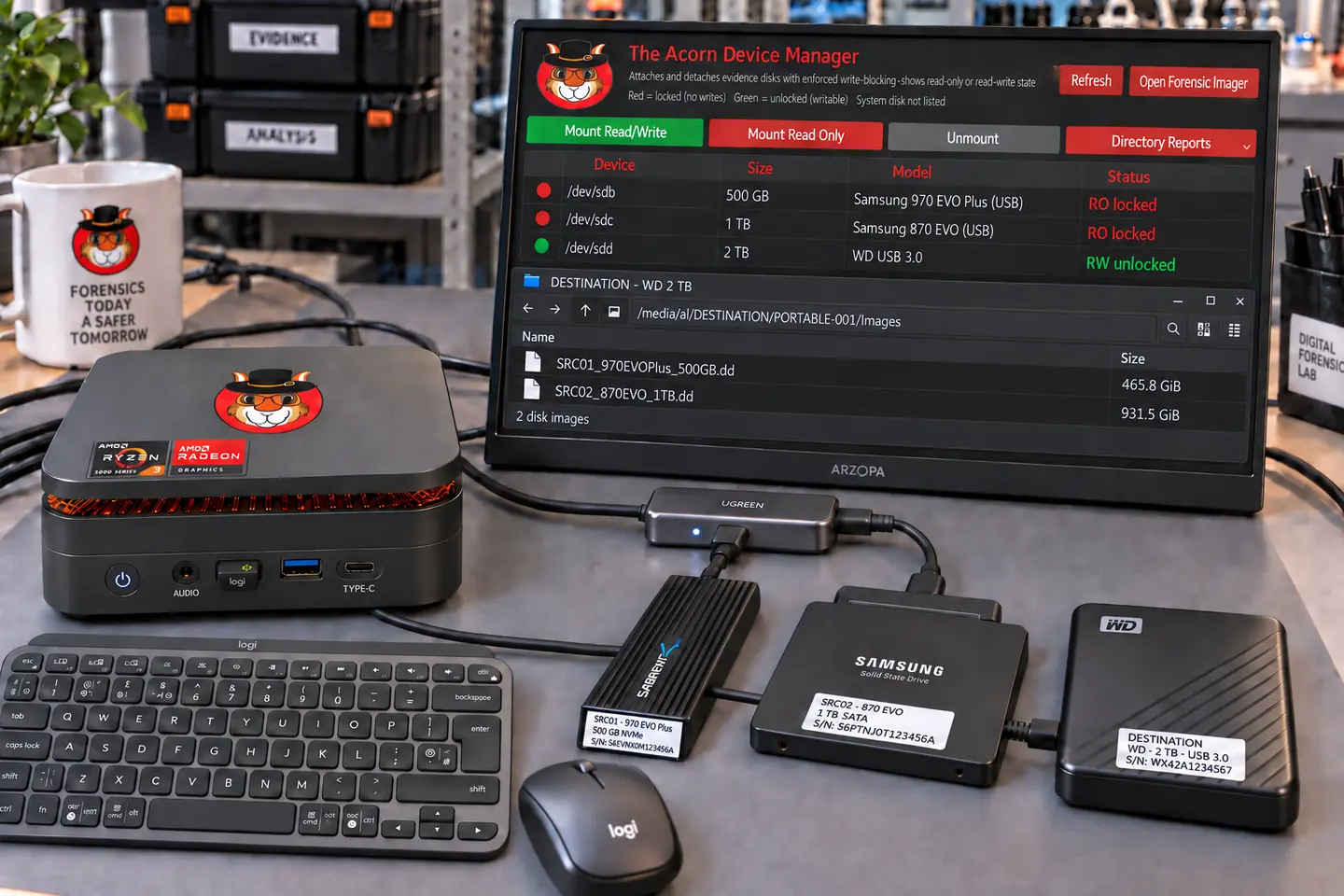
Illustrative Acorn workspace for education & training

For lecturers, students and training providers

Give students evidence.
Ask them to explain it.

Turn acquisition, artefact review and recovery into practical lessons with a known starting point. Students can use real forensic interfaces, test a hypothesis and show how they reached an answer.

Explore the workflow

Planned release Q1 2027 · Explore the workflow and check build support.

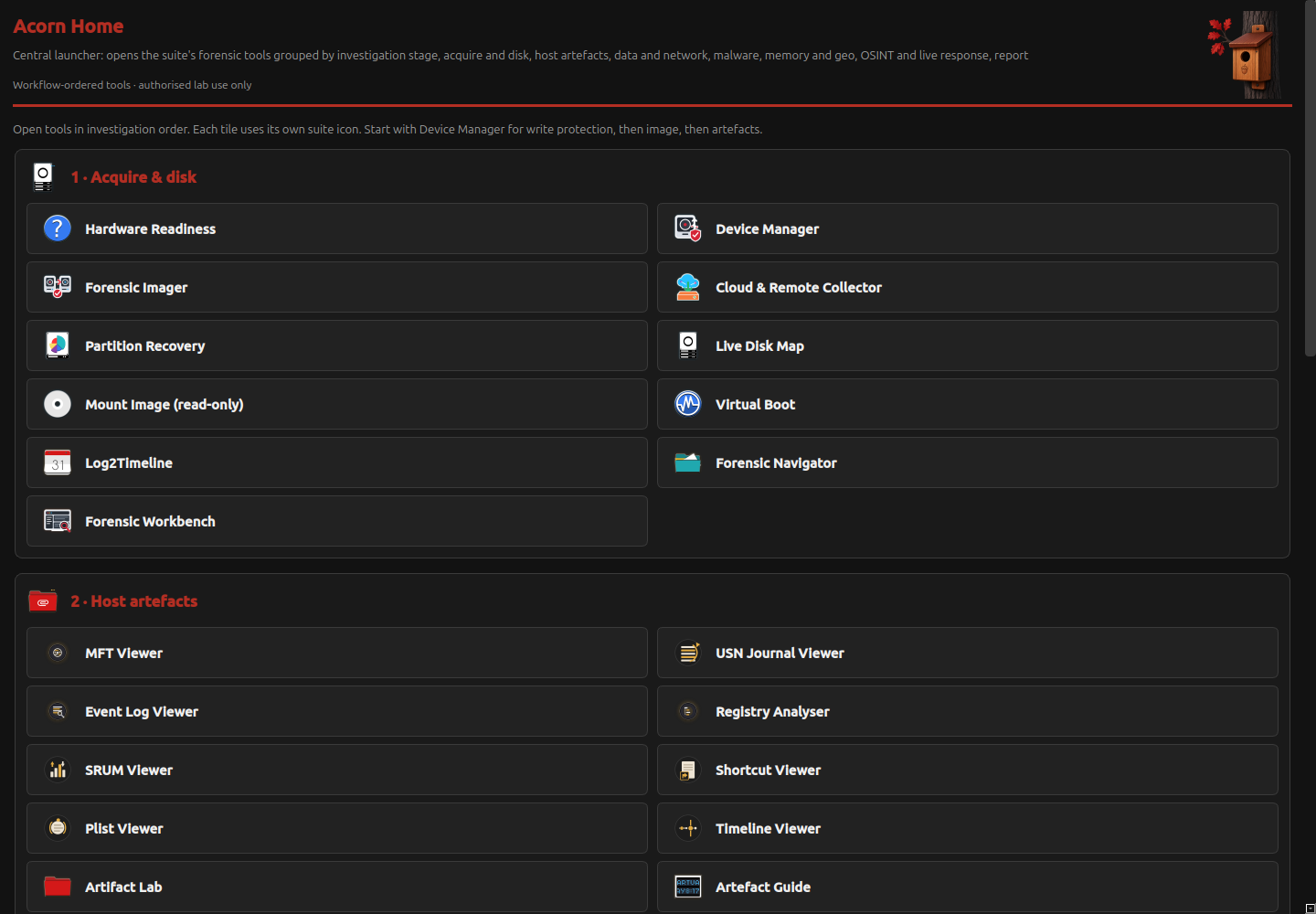
The Acorn home interface provides routes into its forensic applications. Teaching scope and app availability should be agreed for the edition supplied to the class. View full screen
The Acorn home interface provides routes into its forensic applications. Teaching scope and app availability should be agreed for the edition supplied to the class.
Education & training Sleuthy sector illustration

Education & training

Teach more than which button to press

A strong practical is more than a successful button click. Students need to recognise the source, inspect records and decide whether a finding answers the question. Known teaching data gives the instructor something concrete against which to assess that reasoning.

Acorn provides the forensic operating environment, with Workbench for case review and focused apps for individual artefacts. Map a practical to a learning outcome: preserving a source, explaining a timestamp, comparing parsers or reporting a bounded finding. A repeatable dataset and clear marking criteria matter more than the number of applications a student opens.

Connect the tool to the learning outcome

Choose the forensic decision students should understand, then select the relevant workflow. Separate acquisition, parsing and interpretation so a successful operation is not mistaken for a justified conclusion.
Make the practical repeatable

Keep a verified teaching master, expected records and a reset procedure. Record the software build and exercise settings so a difference between student results can be investigated rather than guessed at.

Assess an explanation, not a screenshot

Ask students to identify the source record, justify the conclusion and propose a further check. Their report should make sense to someone who did not watch the practical.

EXAMPLE WORKFLOW

Suggested practical: did a cloud-service visit prove an upload?

Students receive a constructed browser History database and a short brief about a document. Their task is to investigate a possible transfer and explain what the records can establish.

  1. Examine the starting material

    Provide the same verified dataset, software build and collection note. State the learning outcome, then ask students to identify the database, record types and period before proposing an explanation.

  2. Review and compare the records

    Filter the visits and inspect a relevant period in the timeline. Follow selected entries back to their source rows, compare stored and displayed times and record the steps used.

  3. Present and challenge the conclusion

    Ask students to distinguish a visit from a transfer, cite the supporting source rows and propose a corroborating source. Use peer review and a short marking guide to assess reasoning, reproducibility and recognition of missing evidence.

Suggested teaching exercise using constructed data, not an accredited course or a claim of university endorsement.

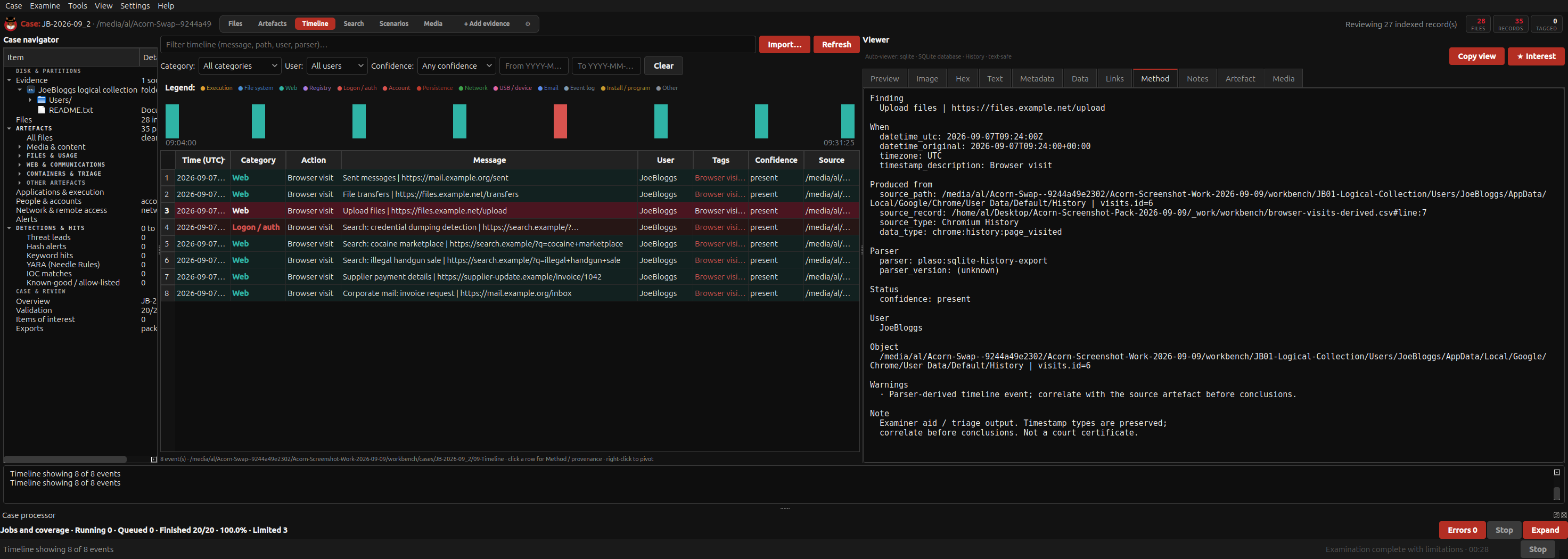
Browser visit rows imported into the Acorn timeline from a constructed History database. Original visit IDs and source paths support checking the exercise against its inputs. View full screen
Browser visit rows imported into the Acorn timeline from a constructed History database. Original visit IDs and source paths support checking the exercise against its inputs.

A proposed 90-minute practical

From a record to a reasoned answer.

15 minutes / Frame the question

Give students a known training dataset and an examination question. Record source hashes, scope and time-zone assumptions.

45 minutes / Examine and compare

Review a timeline and a second artefact source. Ask students to identify an observation, an inference and a gap.

30 minutes / Defend the answer

Exchange findings, check source references and discuss alternative explanations. Assess reasoning, not the number of alerts.

Suggested lesson structure, not an accredited course or a claim of a completed institutional deployment.

A useful evaluation

Bring the requirements that matter.

  • Curriculum outcome and student experience
  • Verified dataset, reuse rights and working copies
  • Build, expected records and reset procedure
  • Academic licence, instructor support and assessment
Explore the focused applications ↗
Can this support both introductory and advanced classes?

Yes, an instructor can vary the question and expected explanation. An introductory group might interpret one artefact; an advanced group could compare sources or parsers and review another student's method. Map the exercise to your own curriculum and assessment.

What should we confirm before planning a laboratory module?

Discuss class size, equipment, required applications, academic licence terms and support. The proposed new system targets Q1 2027; confirm the edition and timetable before making it essential to a module.

How can students repeat a practical?

Keep a verified teaching master and issue working copies. Record the build, settings, expected records and reset steps. After an update, rerun the practical before class and note any changed results or instructions.

Can we redistribute the demonstration datasets?

Check the licence of each public corpus before distributing it. For your own constructed material, record ownership and provenance and remove any unintended personal information.

The planned 2027 bundle

Take the workspace with you.

The proposed portable bundle pairs Acorn with a workstation, USB-C-powered screen, mini keyboard, mouse and carry bag.

Working specification: 24 GB RAM, AMD Ryzen 9 or Intel Core i9, and a 1 TB PCIe SSD. Final components and compatibility are still being selected.

Explore the planned bundle ↗

COMING SOON · Q1 2027

Target RRP under £3,000 GBP

Provisional specification and price target. Final VAT treatment, delivery, licence terms and availability will be confirmed before orders open.

Notify me + 10% launch offer ↗

No deposit or pre-order is taken here.

Start with your requirements

Design a practical around your teaching

Tell us the concept you want students to understand. We can explore a demonstration, suitable evidence and the proposed academic setup.

About the screenshots and illustrations

Application screens are selected from the September 2026 Acorn screenshot pack. Captions distinguish native setup views, constructed training records and public-corpus results. They are not private client cases, and a displayed control does not establish that every operation was completed.

Relevant public sources include DeepBlueCLI training event logs and Plaso test data. Check the relevant source terms before redistributing an underlying dataset.

Workspace scenes and sector mascot variants are generated illustrations. They do not show actual police, judicial, military or university deployments or endorsements. The original Squirrel Forensics identity is retained.

Zoom in, then scroll to inspect the detail.

Open full-resolution image ↗

A useful first conversation

Let’s look at your workflow.

Tell us what you examine, where you work and what you need to deliver.

Use the enquiry form to outline your role, intended use and potential order quantity. Do not send case material through a general enquiry.

Your enquiry goes to the SQFR team. Please do not include passwords or case evidence.